Showing posts with label roxon. Show all posts

Tuesday, November 4, 2008

Taking it back to Mr. Rudd.

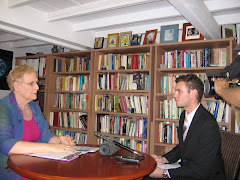
Members of the Need More GPs group met with the Prime Minister Kevin Rudd’s representative on October 31, at his Griffith electorate office.
We pointed out that the ideas (in respect of the critical GP shortage) that we put to Mr Rudd at a meeting in May (and to Nicola Roxon in September) still have not been satisfactorily addressed despite a welter of correspondence from Canberra public servants.  Mr Samuel Walker, of the Prime Minister’s Griffith electorate office, said he could understand our concern, and undertook to refer the issue back to the relevant Departmental officers.
In summary, our suggestions to relieve the GP shortage in the short to medium-term are:

1.To assist the urban crisis: a short moratorium (say, 6-12 months) on the provider number restriction, with some other conditions: only Australian residents or citizens who are fully registered and have a demonstrable urban commitment. This could allow an uptake of IMGs into urban practices at risk of closing, without causing an exodus from the bush
2.A reduction of the time-limit on IMGs obtaining unrestricted provider numbers from 10 to three years. Three years seems a reasonable amount of time to demonstrate a commitment to the country. It is also short enough to make up skilling not too much of an issue for IMGs who have not found work in Australia for whatever reason. We also suggest that as a three-year requirement is less intimidating than a 10-year one this may increase the number of doctors prepared to consider going to the bush.
3. A ‘Welcome Back’ package; an up skilling and mentoring program to assist doctors return to work and temporary assistance to GPs who wish to work part-time while their children are under-school age, in the form of a subsidy of their medical indemnity cost, to be repaid (as is the student HECS bill) when their working hours increase substantially.
4. Increase rural Medicare rebates by 20-30%.  At present there is no difference income-wise between rural and urban doctors.
For a fuller discussion, please go to "The Solutions Discussion" link at the top of the sidebar. 

Thursday, October 30, 2008

Aussie Doctor, Aussie Trained, Overseas Rules Apply.


 “How can you call someone a foreign doctor when they are an Australian doctor with an Australian degree, and they were classed as a local student from day one?”

Good  Question, Dr .Belich.


Mike Belich was born in New Zealand, but has lived in Australia since the age of 14. He graduated from the Medical School of the University of NSW in 1999, and is currently working in Byron Bay where he is completing his RACGP training. When he passes his Fellowship exam however, as he is classed as "a former overseas student" (although he was considered a "local student" when he enrolled) he is subject to the same regulations as International Medical Graduates - in other words must work for ten years in a District of Workforces Shortage before he will be eligible for an unrestricted provider number.

There are apparently about a hundred doctors in the same situation as Dr. Belich. 

Dr Belich's story was in the The Australian on Wednesday October 29 (first edition), and a link will be made to this just as soon as it is available.


A spokesperson for Health Minister Nicola Roxon said that she (Ms Roxon) he is  "aware of the situation and is currently looking into what can be done."


Representatives of The Need More GPs group specifically mentioned Dr Belich's case to Nicola Roxon when they met with her in September (see post below) to discuss GP workforce shortage issues.


Saturday, September 13, 2008

Our Meeting with Nicola Roxon.

Representatives of our Need More GPs group were invited to a meeting with Nicola Roxon on Tuesday 9th September. We are still considering our formal response at this time, but in summary, we feel that:

Nicola Roxon knows the horse is sick

She knows the cart needs repairs

However she is focused on building the barn.

Do we need to say that we fear that the GP section of the barn will be empty, unless some urgent interim action is taken?

Saturday, August 30, 2008

UK - Trained GPs ready to help us.

It seems that help for our GP workforce shortage problem is waiting in the wings - or could be, if the powers that be would allow it. 

We have received the following email from Mr Ron Crause, Chairman of the Australian Association of Medical Recruitment Agencies (AAMRA).

"I have read your submission to Mr Rudd. We at AAMRA would be most supportive of your initiatives. I thought I would also bring to your attention that the last federal government introduced, under Mr Abbot a program in 2004, called Strengthening Medicare which has been very successful in bringing in over 600 GPs into Australia during this period. This program has not been renewed by the current government even though tenders went out for it in December 2007. Submissions have been made to Ms Roxon to entreat her to continue the program but without any success.  With the current economic downturn in the UK we have the opportunity to get some really good UK trained GP’s and the continuation of this program or anything similar would also help."

So, Mr. Rudd and Ms. Roxon, what is the go here? Is there some really good reason that that this program has not been continued? If there is, please tell it to us - and especially our rural colleagues.

Recruiting GPs from a developed nation such as the UK avoids the ethical dilemma of taking doctors from countries that can ill-afford to train them in the first place, never mind then losing them to wealthier countries.

Tuesday, March 18, 2008

“After-Hours”

An open letter to the Hon. Nicola Roxon, Federal Health Minister.

In response to the local publicity on the GP shortage in the Stones Corner/Greenslopes area you were reported as pointing out that OTDs can in fact work in designated ‘Inner Metropolitan’ areas – provided that they work after-hours (i.e 6 pm to 8 am).

This response, Ms. Roxon, is unsatisfactory. It is clearly the response provided to you by your advisors. It is patronising and unhelpful. It serves only to highlight the abyss that gapes between GPs working at the coal-face and bureaucrats working from their ivory towers.

I one wants to find out about knitting, one does not ask a carpenter. May I respectfully suggest that if you want to find out what is really happening in general practice on a day-to-day basis, that you do not ask a bureaucrat.

I offer the following comments, which I would be grateful if you would pass on to your Departmental advisors during your next discussion.

1. If you are suggesting that each individual practice could solve their workforce problem by employing an OTD after-hours, could you please explain how this would assist a practice which cannot find a doctor to fill the morning shift from Monday to Friday to meet their accreditation requirement (based on the RACGP Standards) to have a doctor available during office hours (8 am to 6 pm)? As you are aware, practice accreditation is linked with remuneration, and hence financial survival.

2. In any case, to suggest that every small individual practice could afford to employ an after-hours doctor is ludicrous. It would necessitate the employment of after-hours administration and security staff, which would be financially impossible for every practice I know. Some of the large corporate practices tried this in Brisbane some years ago, but even with their economies of scale, they were not able to make it a viable business proposition. There may be two remaining 24 hour practices left in Brisbane.

3. Inner metropolitan practices do in fact employ OTDs ‘after-hours’ – but most do it via a subscription to the commercial After-hours service.

4. This ‘solution’ is equally unnacceptable to the community if it is offered as a substitute for availability during office hours. A mother of an infant is not going to want to take her child for routine vaccination at 9 at night because the practice does not have a doctor available at another time, nor is a frail elderly lady going to venture out on her own late at night to get her blood pressure checked.

I look forward to your response.

Yours sincerely,

Dr Janet Clarkson

Logan Road General Practice.

Thoughts on Super Clinics.

An open letter to Mr. Rudd and Ms. Roxon, from a GP at the coal-face.

Dear Mr. Rudd and Ms. Roxon,

I would like to make the following comments in regard to the Super Clinics which you have offered as a solution to the GP shortage.

1. Unless there is a net increase in the total number of GPs, this simply represents people-moving.

2. These Super Clinics are apparently to be staffed by the large number of GPs that you 'hope’ will result from the increased number of medical students currently attending our universities.

(i) Assuming that this increased cohort does eventuate, it will not be for nearly a decade. Do you have any strategies for our survival in the meanwhile?

(ii) One quarter of the current Year 1 students at the University of Queensland School of Medicine are overseas students, who will not be allowed to stay in the country after they graduate.

(iii) Of the remaining 303 Australian first-year students, assuming that they all complete their course, is it not a fantasy that a large number will become GPs given that:

(a) it is acknowledged that the popularity of the general practice as a career choice has been declining world-wide for years.

(b) this has been reflected in a decreasing number of applicants for each general practice training place for a number of years. We understand that in the late 1990’s there were three applicants per place, compared to 1.1 applicants per place in 2005.

(c) there are said to be sufficient training places in specialist colleges that every student could access one of these, making it theoretically possible that there could be no applicants at all for the general practice progam.

To build a concept of Super Clinics based on what can only be called optimism of the highest order can surely not qualify as a strategy, can it?

3. The Super Clinics are apparently going to attract these mythical graduates on account of the state-of-the art facilities that they will offer. This sort of statement, Mr. Rudd and Ms Roxon, is, quite frankly, an insult to future and current practitioners.

4. The Super Clinics are to be subsidised by governement. Will not this represent unfair competition to GPs who have struggled to maintain their community practices for years? I do not know if it is unconstitutional. I do not know if it breaches the Trade Practices Act. I do know that it is unfair.

5. And finally, in your reply to our letters regarding the local problem you described the planned Super Clinic concept. As, by your own definition, Super Clinics will be set up in Districts of Workforce Shortage, and, by your own definition, this area (Stones Corner and Greenslopes) is not a District of Workforce Shortage, can you please explain how this will help solve the local area problem?

Yours sincerely,

Dr Janet Clarkson,

Logan Road General Practice.

UPDATE, 27 March, 2008

Proposal to pay incentives to doctors to work at Super Clinics; read the Medical Observer Article.